I’m encountering an issue with division in my PLC program. I need to divide the data from a DWORD tag, which is assigned to an encoder module, by a constant value. The encoder module only allows the assignment of DWORD tags, so I’m receiving pulse data in this DWORD tag. However, when I try to use the division block, it doesn’t show the PLC variable that I have assigned for the pulse data. Could you guide me on how to divide a DWORD tag by a constant value? DIV block not allow me to assign any DWORD tag , it allows DINT but, DWORD 7 digit value is not converting to DINT.


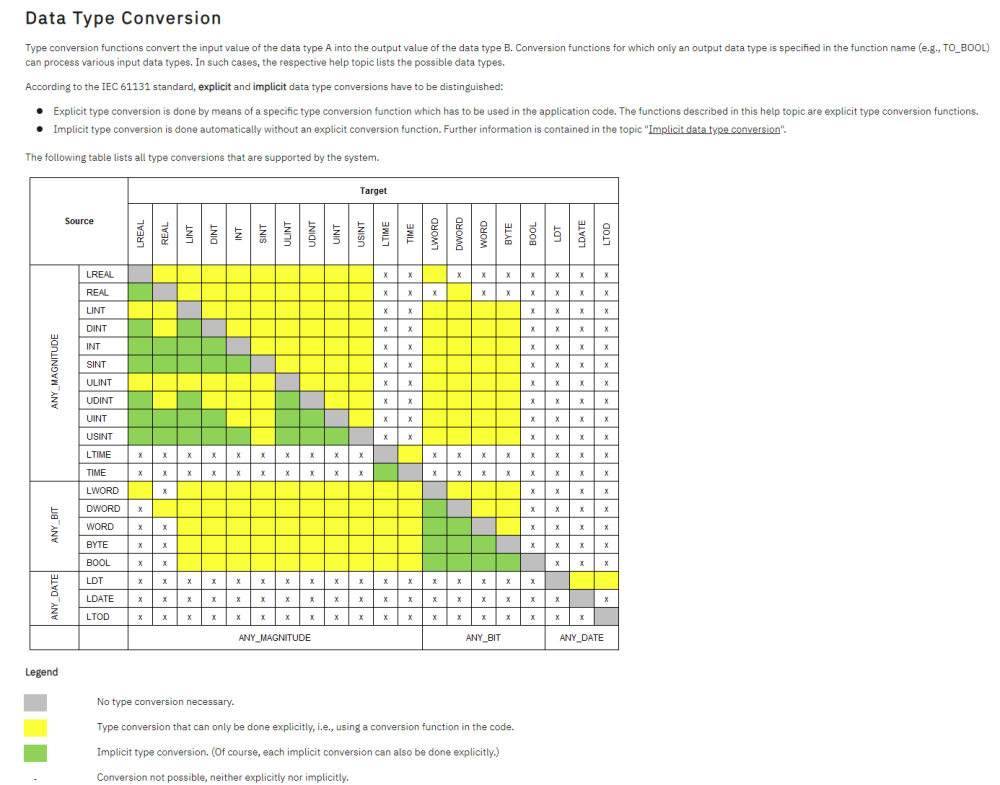
DWORD can indeed be converted to a DINT as both are 32bit values.
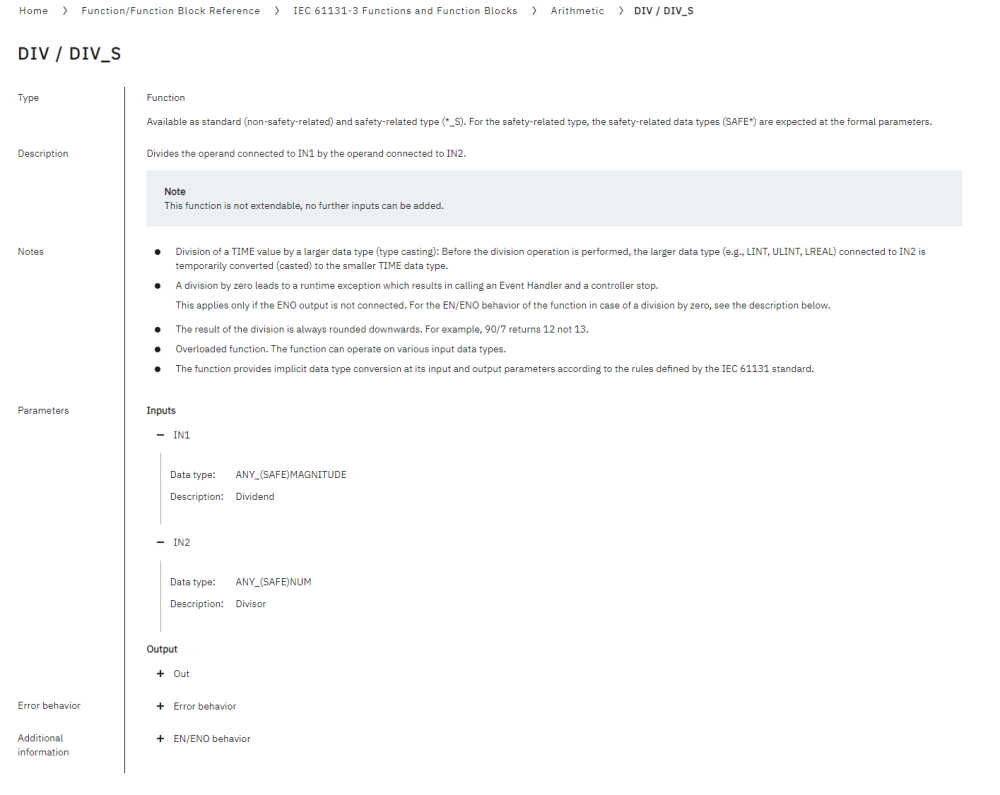
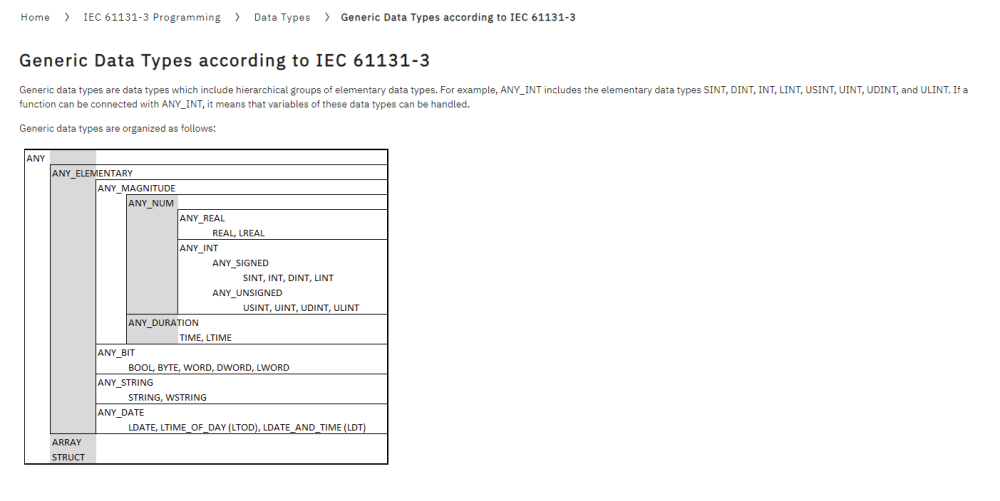
The DIV function only takes “any_num” as inputs.
On the DIV-input you can try this: TO_DINT(myDWORD), and your constant at the other input

Have you tried something like this?</p>[https://forum.plcnext-community.net/uploads/DLWJ8IJ24QGN/image.png</a></p>SFW</p>
[upload://qpe1aVsFY5bikU2042xnbi6NDm6.png</a></p>DWORD can indeed be converted to a DINT as both are 32bit values.</p>The DIV function only takes “any_num” as inputs.</p>On the DIV-input you can try this: TO_DINT(myDWORD), and your constant at the other input</p>[upload://lFr9IRqwvpC3hSaOg5jhGEMkVE2.png</a></p>[upload://ta8HWWfYGaYxSo1VaQFuBCuv4n1.png</a></p>
Hello Steve,
Hello Fluxmodel,
I truly appreciate your support, thank you very much.
Initially, when I tried to convert a DWORD to a DINT, the output value was incorrect and appeared with a negative sign. However, after restarting the software and reading your comment that both DWORD and DINT are 32-bit, I tried the conversion again, and it’s now working correctly. I simply converted the DWORD to a DINT and assigned the DINT to the DIV block. Thanks again for your assistance.
Regards,
Ali
FYI a negative sign for a DINT is not incorrect… it ranges from
-2,147,483,648 to 2,147,483,647